

Close Read is my ongoing series where I work through my physical Criterion Collection in spine order — watching, researching, and writing a deep dive analysis of each film. I’m not a film academic. I’m just a reader and a writer whose favorite hobby is unpacking themes and symbolism. Which I think counts for something!
The first film in my collection is #20: Sid and Nancy (1986), directed by Alex Cox. This probably goes without saying, but uh, there will be spoilers throughout.
Before watching this film for the first time last year, I didn’t have much experience with the Sex Pistols. Or much background knowledge of the UK punk scene at all. And yet, I was still aware of the myth that is Sid and Nancy. Even after 40 years, their story remains in the cultural zeitgeist, and they are still one of the most recognizable Halloween couple costumes. In 2021, Kourtney Kardashian and Travis Barker dressed as them, handcuffed together, captioning the photo “till death do us part.” This film has been criticized for inspiring these very costumes rather than capturing real punk authenticity. Sid and Nancy have become shorthand for a doomed romance that transcends punk entirely. They became legends by fulfilling the classic teen archetype: “live fast, die young, leave a good-looking corpse.”
When the film was released in 1986, it was not well received by Sex Pistols fans, nor by the band's remaining members. Johnny Lydon (aka Johnny Rotten, lead vocalist) said this in his book, Rotten: No Irish, No Blacks, No Dogs:
“To me, this movie is the lowest form of life. I honestly believe that it celebrates heroin addiction. It definitely glorifies it at the end when that stupid taxi drives off into the sky. That's such nonsense. The squalid New York hotel scenes were fine, except they needed to be even more squalid. All of the scenes in London with the Pistols were nonsense. None bore any sense of reality. […] I don’t think they ever had the intent to research properly in order to make a seriously accurate movie.”
In a later interview, Johnny was asked the question, “Did the movie get anything right?” to which he replied, “Maybe the name ‘Sid.’” lol
I certainly can’t blame Johnny for being upset about the portrayal of his close friend. After all, this was his real life. But it does bring up an interesting question: Who gets to tell one’s story? Is artistic interpretation owed to the people who lived it? Personally, I don’t really buy the argument that a filmmaker has any responsibility to the truth. Besides, I watched some of the footage from the D.O.A.: Rite of Passage documentary, and I’m not sure I’d want to spend two hours watching the real Sid and Nancy anyway…
Luckily, I was able to go into this film with very little baggage. I watched this not as a biopic, but rather a crash-and-burn love affair between two deeply troubled people.
The film was not a box office hit. The late 1980s were supposedly a tough time to release a movie that attempted to capture the punk rock spirit. When the punk movement began, it wasn’t just about the music. It was a direct response to Britain in a crisis. Thatcher’s privatization, deregulation, and cuts to social services at this time led to widespread unemployment and inequality, essentially eroding working-class communities in the UK. What came of it was a generation of folks with nothing to lose. Hence, the punk rock spirit was born! It turns out “Anarchy in the UK” wasn’t just a provocative song title. But while the punk lifestyle encapsulated the socio-economic and political climate of the late 1970s, by the time this film came out, the resistance had already failed. With this context in mind, the film reads not only as a tragic love story between two punks but also as an elegy for a movement that burned bright and got swallowed up by the system. Just like Sid.
As I talk about the film from here on out, I want to make it clear that any mention of these characters is specifically referring to their portrayal in the movie, not the real people.
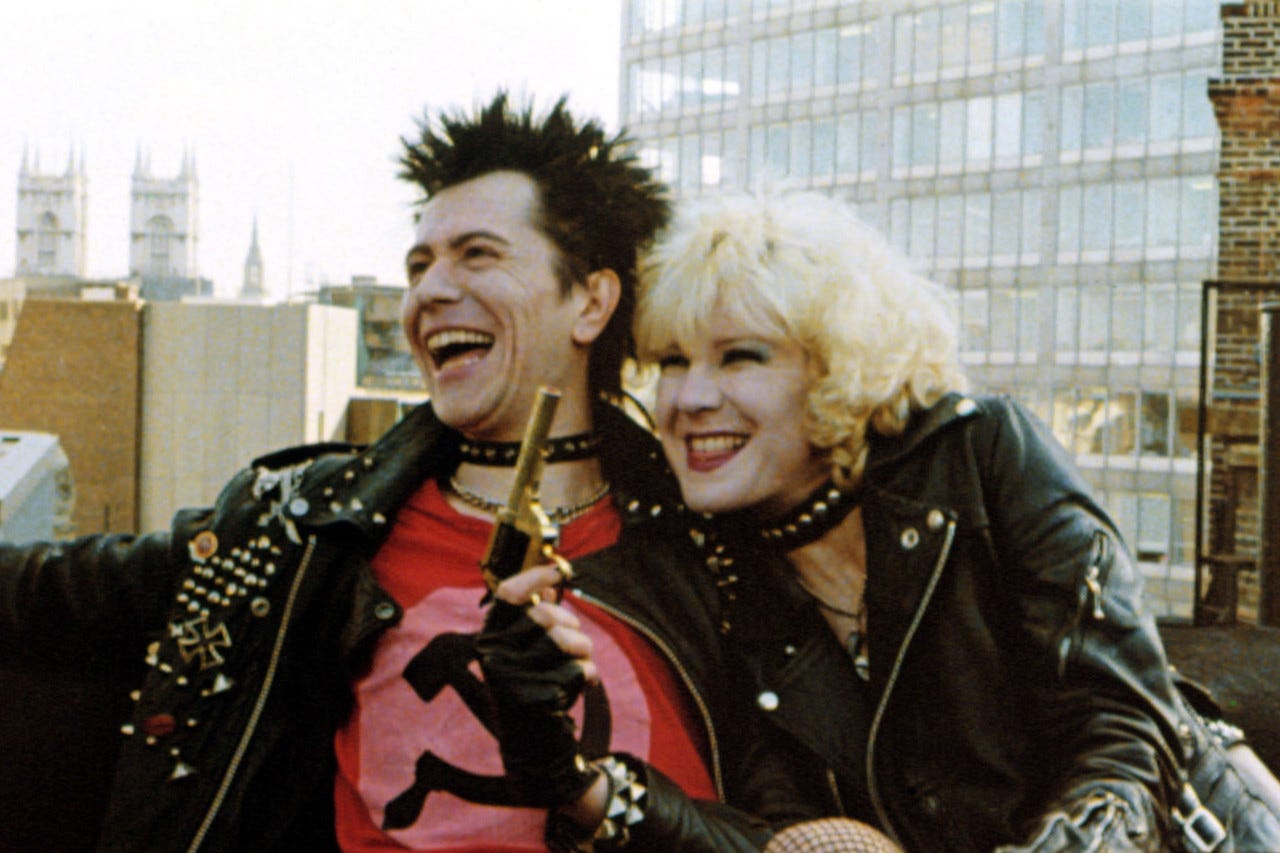
The film opens on October 12, 1978, when police find Nancy Spungen dead in the Chelsea Hotel. Her boyfriend, former Sex Pistols bassist Sid Vicious, is taken into custody and told to describe what happened. We are transported through a flashback to the previous year, when the Sex Pistols were at the height of their fame. This is the fun part. The (no) sex, drugs, and rock n’ roll part. It’s a brash, rowdy black comedy that showcases the punk scene in all its bad taste glory.
Sid and Johnny meet Nancy, an American groupie who had come to London to follow these hot new punk bands. She is dismissed by the band at first, as her intentions are quite obvious.
Johnny: Fuckin’ Americans. That’s all you ever think about: sex. None of us fucks, see? Sex is ugly. None of your free hippie love shit here.
“Sex is boring,” as Sid tells her that night, but they begin dating soon after when he feels sorry for her after watching her get rejected by some other punk. It is implied that Nancy introduces Sid to heroin soon after, and they swiftly fall into a self-destructive, drug-fueled relationship that frays Sid’s relationship with the rest of the band.
There is a great sequence during the Sex Pistols’ disastrous Silver Jubilee celebration where the two are walking together as the people around them are running from the police. It’s one long tracking shot backwards as they make their way through the mayhem like ghosts. It’s really quite beautiful, and gives us a sense that these two really do belong together. Just them against the world, moving through chaos.
When the band sets off on a month-long American tour, it is notably disastrous. Now fully addicted to heroin, Sid is strung out of his mind and starts getting physically violent during their shows. While everyone attempts to help and warn Sid about his relationship with Nancy, he stubbornly ignores them. In the midst of their tour, the band breaks up.
Now in America, and now without a band, the tone becomes progressively more bleak and claustrophobic.
Sid reunites with Nancy in New York City, and she convinces him that he could have a solo career. Unfortunately, this attempt is fruitless as Sid is now considered a washed-up has-been. They end up settling in the Chelsea Hotel, where they live in squalor and descend deeper into their heroin addiction. One of the most notable shots in the entire film is when they kiss against a dumpster in an alley while garbage slowly falls all around them. It’s a pretty obvious metaphor for their relationship — passionate and doomed. These two are divorced from the world, still loving each other as everything comes crashing down.

The film ends tragically one night during an argument when Nancy attacks Sid and begs him to kill her. They start fighting in a drug-induced haze and Sid stabs her. (Whether it was intentional is up to interpretation.) The two fall asleep and later Nancy stumbles into the bathroom where she collapses and dies.
Now caught up to the events of the opening scene, Sid is bailed out temporarily by his mother (who is also a heroin addict) and we watch as he wanders into a restaurant and then disco-dances joyfully to KC and the Sunshine Band with a bunch of kids. This highlights how Sid really was just a young kid, vulnerable and insecure. This sentimental ending should probably feel like a relief, and yet, it reads more devastating considering we know what happens next. (Hint: he overdoses.)
The final shot of the film is a taxi picking Sid up, where he finds an alive Nancy in the backseat. The two embrace as the cab seemingly drives off to…the afterlife? One of the biggest criticisms of the film, aside from the inaccuracies, is that this film glorifies Sid’s self-destruction. I suppose this scene is what they mean…
When Alex Cox was asked what he would do differently if he remade the film in 2016, he stated that he wouldn’t have done the sentimental, happy ending. There is a scene where Sid and Nancy go to the methadone clinic and they are refused methadone until they admit that they have betrayed the punk movement and themselves. Cox said that this was his point of the film and that the quasi-happy ending undercuts that.
“The punk movement was essentially a positive moment that was supposed to be forward-looking. You can’t do that if you’re a junkie rock star in a hotel room. […] If I was to remake it, I would end it with Sid dying in a pool of his own vomit.”
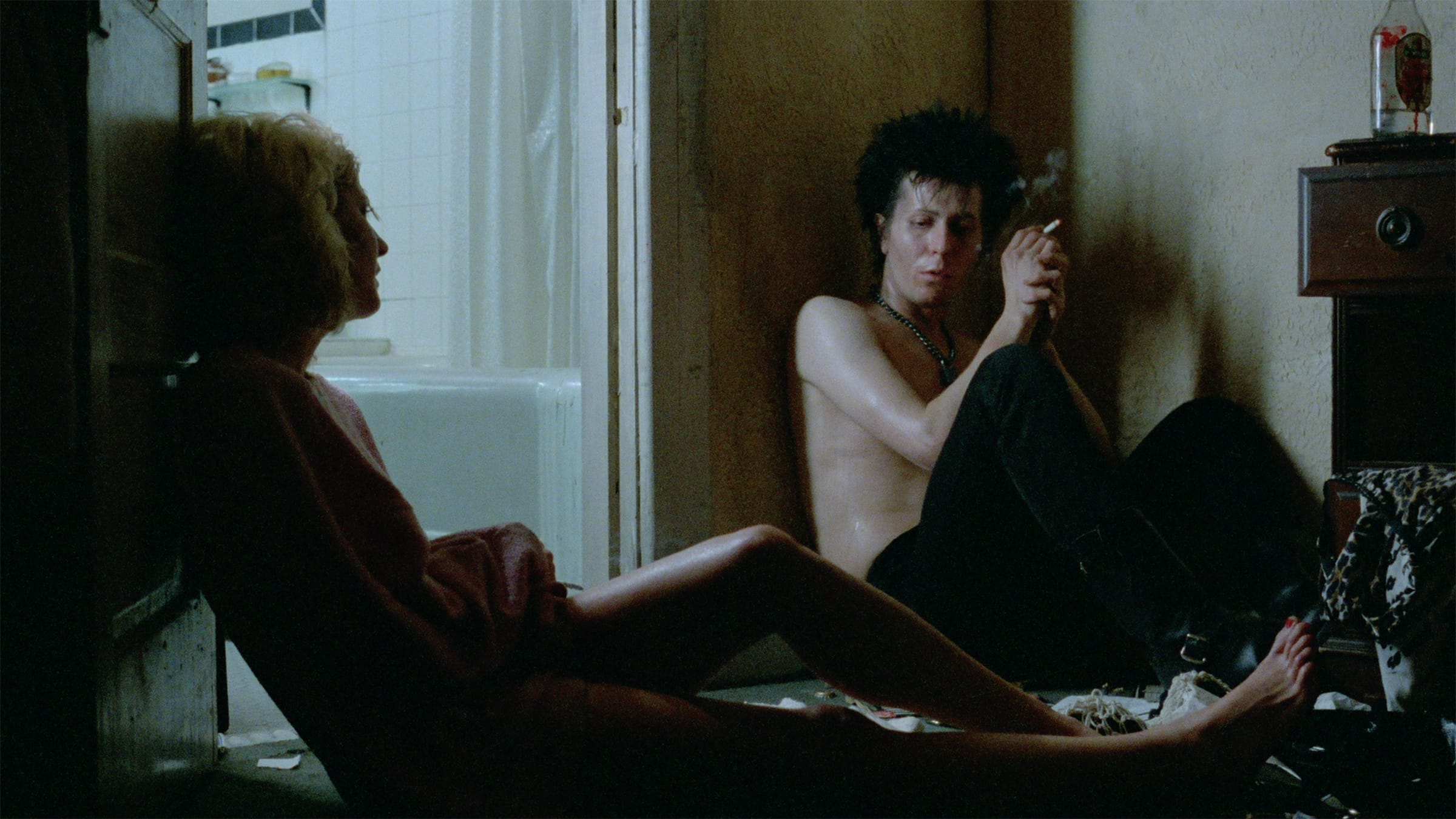
As for the criticisms saying the film glorified drug use in general, I have to ask… did you see the movie?? There was nothing about Sid and Nancy’s self-destruction that appeared to be fun. There were no fun-time drug partying scenes. When Sid tries heroin for the first time, we immediately see him hugging the toilet afterwards. That doesn’t necessarily make you want to run out and give it a go... But this leads to another interesting question: Does making a film about something automatically mean it’s glorifying it? In my opinion, the film never makes Sid out to be a hero. In fact, they are both pretty unlikable throughout the entire film. That’s not to say we don’t feel sympathy for them, but it’s more in the broader sense. Mostly, you just feel sad that it is even possible for someone to make themselves this unhappy.
Despite this being his breakthrough big-screen performance, Gary Oldman has been pretty vocal about how he was not initially interested in the role, even saying that he turned it down twice. In the audio commentary, he stated, “I had no interest in the Sex Pistols. I looked at it and thought, ‘Why? Why would you make a movie about these people?” But I don’t believe the film asks us to like these characters, and it does not shy away from showing that they are very flawed, volatile people. Reminder: you don’t have to like a character (or the subject matter) for a movie to be good!
While I believe this film works well as a warning against drug abuse, I also found that it emphasized the greedy capitalist nature of the music industry. There is quite a bit of irony in record labels capitalizing on punk during this time. Bands who were once at the forefront of this anti-establishment movement were now finding themselves caught between their own punk-rock ideals and the glittering promises of the industry. When The Clash signed a major label with CBS Records in 1977 for £100,000, it was seen as a massive betrayal of everything punk stood for.
Cut to a 17-year-old Sid Vicious, the poster child for this kind of industry exploitation. He was a kid with no prospects, handed an insane amount of fame, and essentially told that his value was in staying dangerous and fucked up all the time. When you’re otherwise unemployable, this seems like a pretty damn good gig.
The film essentially has two acts, and there’s a pretty clear line dividing them: there’s the British half and the American half. Through Roger Deakins’ cinematography, we can map the film’s emotion as we transition from one to the other. When in Britain, the scenes are bright and colorful, reflecting the spirit of the punk rock movement — vibrant and alive. As the two make their way to America, and they start to descend further into addiction, the scenes become much more monochrome and shadowy.
Even amongst critics of the film, Gary Oldman and Chloe Webb have still been praised for their performance and commitment to the roles. Chloe does a great job portraying Nancy, who was often described as being miserable and annoying, with humanity and compassion. (I won’t comment on my suspected misogyny on this front, but… just know I have it.) In one of the most emotion-heavy scenes of the film, the couple is in a telephone booth trying to get money from Nancy’s parents. They refuse, which sends Nancy into an emotional spiral. (“They said we’d spend it on drugs!” “Well, we would!”) Webb commits so hard in this scene that she actually breaks the real glass in the photobooth, not just the sugarglass pane made for the scene. With a similar level of commitment, Oldman reportedly undertook such a drastic diet to achieve Sid’s emaciated physique — a diet solely of steamed fish and melon — that he was diagnosed with malnutrition at one point!
There is a great scene where Oldman recreates Sid’s performance of Frank Sinatra’s “My Way.” The original was filmed for The Great Rock ‘n’ Roll Swindle, a mockumentary about the Sex Pistols filmed shortly before he died in 1979. In the context of the film, this scene is presented more as a fantasy rather than a performance. It suggests that underneath all of this punk nihilism, Sid really was just a kid who wanted to be adored, and that the line between rebellion and performance is thinner than a lot of punks want to admit.
Overall, this film worked for me, and I ended up liking it more this second time around. My only critique is that I would have liked to have seen more exploration of why these two were so drawn to each other in the first place. It seemed very sudden that we jumped from “sex is boring” to a murder-suicide pact. Although thinking on it further, that may have been a deliberate choice, considering there probably wasn’t much rationality to their relationship to begin with.
As for its place in the collection, Criterion likes to select films that defined a moment. The punk movement was a genuinely significant moment in the UK, and this is one of the few serious cinematic attempts to capture it. (That I know of.) That’s not to say the film is a perfect representation of the time (just ask any Sex Pistols fan), but I can’t really think of a more perfect way to capture the punk spirit than one that is imperfect. To make a polished film about the punk experience would appear nothing more than a lie, if you think about it.
Whether it is based on complete truth or not, Sid and Nancy is essentially a portrait of the inner turmoil of a destructive relationship. These two are so fucked up, so hopeless, that they could only really love each other. In a way, they really are meant for each other — but even in their own fantasies, the two were doomed. This film shows the tragic love triangle between two troubled people and the heroin that destroyed them both.
Nancy: When I’m dead, will you be sad?
Sid: I couldn’t live without you.
Nancy: You couldn’t?
Sid: No.
Nancy: We better go together then.
These two were sort of a fucked up, punk-rock Romeo and Juliet — and what's more timeless than doomed love?
My Rating: ⭐️⭐️⭐️⭐️
Thanks for reading, dolls! And if you find any typos, they were a creative choice. 💋